Methodological and statistical considerations in the assessment of GH-IGF-1 axis dysfunction and linear growth in children with type 1 diabetes mellitus
LETTER TO THE EDITOR
Methodological and statistical considerations in the assessment of GH-IGF-1 axis dysfunction and linear growth in children with type 1 diabetes mellitus
Article Summary
- DOI: 10.24969/hvt.2026.662
- CARDIOVASCULAR DISEASES
- Published: 02/07/2026
- Received: 29/06/2026
- Accepted: 30/06/2026
- Views: 30
- Downloads: 14
- Keywords: Growth hormone, insulin growth factor-1, linear grown, children, type 1 diabetes mellitus, methodology
Address for Correspondence: Umair Moin ud din, Khawaja Muhammad Safdar Medical College, 51310, Sialkot, Pakistan
Email: umairmoinuddin6@gmail.com Mobile: +923278769811
ORCID: 0009-0003-8360-0852
Letter to the Editor
Methodological and statistical considerations in the assessment of GH-IGF-1 axis dysfunction and linear growth in children with type 1 diabetes mellitus
Key words: Growth hormone, insulin growth factor-1, linear grown, children, type 1 diabetes mellitus, methodology
Dear Editor,
I read the cross-sectional study titled “Association between disease duration, growth hormone (GH)-insulin growth factor (IGF)-1 axis markers, and linear growth in children with type 1 diabetes mellitus (T1DM): a cross-sectional study” by Uvaidillaeva et al. (1) published in Heart, Vessel and Transplantation and found it interesting to learn more about how long duration T1DM can affect children during their growing years. This article is a valuable addition to the field of diabetology. However, I would like to draw attention to some findings in this study that need further discussion. Addressing these points would increase readers’ confidence in conclusions drawn.
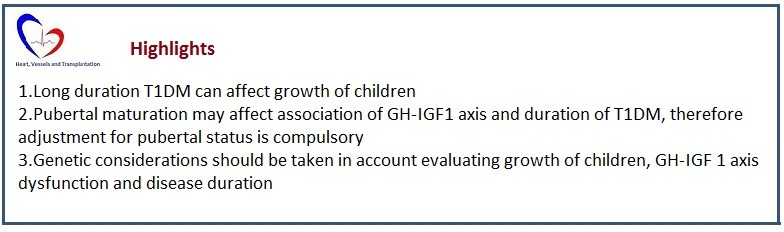
The most concerning point is the absence of adjustment for pubertal maturation. IGF-1, like height, the sex steroids and Tanner stages, rises steeply in individuals during puberty, with the timings of the rises tightly synchronized within individuals (2). This manuscript neither reported Tanner staging nor statistically adjusted for it. As the study population ranged from prepubertal childhood to adolescence, the observed associations may have been influenced by variations in pubertal status across the disease duration groups. As a result, the reported inverse relationship between disease duration and IGF-1 SDS may have been confounded by differences in pubertal status between the disease duration group rather than a true effect of prolonged disease duration.
A second concern relates to the internal inconsistency of the regression outputs reported in IGF-1 SDS row in Table 2 (1). The reported regression coefficient for IGF-1 SDS is β = −0.245 with a standard error of 0.076, which yields a t-statistic of approximately −3.22 (t=β/SE), while the reported t-value is 1.360. It is noteworthy that, the reported 95% confidence interval (0.046 to 0.254) which is entirely positive and thus inconsistent with the negative coefficient (β = −0.245), as a confidence interval for a negative coefficient should statistically be expected to include negative values. Taken together, these disparities indicate that these values may have been incorrectly reported or calculated. Clarification is necessary before the regression results can be interpreted with confidence.
Third, the negative regression coefficient raises a biological interpretative difficulty, as it points towards the inverse relation between IGF-1 SDS and height SDS after adjustment.
This finding counters the well-established claim that GH-IGF-I axis is a key endocrine mechanism regulating linear growth in children (3). In Table 1 both IGF-1 SDS and height SDS decline with increasing disease duration of T1DM (height SDS: from 0.08 to −0.34 to −1.01 and IGF-1 SDS: from −1.62 to −1.35 to −1.90). This suggests that both of these variables are influenced by disease duration alone rather than having an inverse relationship. While, Table 2 showed a conditional association between IGF-1 SDS and height SDS, which is quite opposite to the unadjusted descriptive trends in Table 1.
Finally, genetics plays a major role in determining human stature. Studies report that resemblances in height between relatives suggest that 80% of height variationis under genetic control with the rest controlled by environmental factors such as diet and disease exposure(4). Without adjusting for genetic determinants of height, the reported findings may have been affected by residual confounding. As a result, the observed variation in height may be partially influenced by genetic factors and not the effect of T1DM disease duration alone.
Umair Moin ud din*
Khawaja Muhammad Safdar Medical College, Sialkot, Pakistan
Peer-review: Internal
Conflict of interest: None to declare
Authorship: U.M. The author solely conceived the idea, drafted the manuscript and critically reviewed and approved the final version
Acknowledgements and Funding: None to declare
Statement on A.I.-assisted technologies use: Authors did not use A.I. in preparation of manuscript
Data and material availability: Not available
References
|
||||||||||||||||||||||||||||||||||
Copyright

This work is licensed under a Creative Commons Attribution-NonCommercial 4.0 International License.
AUTHOR'S CORNER